1. The Road Closed in the Middle of the Journey
Featured passage: Acts 16:6–10
“Come over to Macedonia and help us.” — Acts 16:9, NKJV
Quick context: Paul, Silas, and Timothy are traveling to share the gospel. They have purpose, experience, and apparently reasonable plans—but twice their intended direction is stopped.
Scripture does not describe every detail of how the Holy Spirit redirected them. We simply know that one route closed, then another.
Later, Paul receives a nighttime vision of a Macedonian man pleading for help. The travelers conclude that God is calling them there, and they respond promptly.
They do not abandon their mission.
They release their map.
That distinction matters when life changes without asking permission.
A job disappears. An application is denied. A relationship changes. An injury interrupts the season. A carefully planned move stalls. The family calendar becomes an extreme sport.
Sometimes the route we expected closes while the deeper purpose remains alive.
2. Discern the Detour—Do Not Worship the Original Plan

Biblical text: Paul and his companions are prevented from entering certain regions. After Paul receives the vision, they consider what has happened and conclude that God has called them to Macedonia. They then move in that direction.
Interpretation: The passage shows faithful people being redirected by God, but it does not teach that every difficulty is a supernatural stop sign.
A delayed answer might mean wait.
A failed attempt might reveal a weakness that needs attention.
A financial limit may require a smaller plan.
A person’s “no” may simply need to be respected.
An obstacle might require perseverance, preparation, problem-solving—or an entirely different route.
Discernment is not finding a spiritual-sounding explanation for whatever we already want. It means prayerfully considering Scripture, wise counsel, reliable facts, circumstances, responsibilities, and the character of God.
Paul’s group did not confuse stubbornness with faithfulness. They remained committed to God’s purpose while becoming flexible about the path.
Primary scriptural focus: Paul and his companions remain responsive to the Holy Spirit when their intended routes are blocked, discerning a new direction and moving promptly toward Macedonia.
Central truth: Faithful leadership pursues God-given purpose without becoming attached to one preferred path; it receives redirection with humility and acts decisively when the next faithful step becomes clear.
Hold the purpose firmly.
Hold the route with open hands.
3. Grieve the Route Without Losing the Purpose

Personal-living application: Redirection can be right and still hurt.
A changed plan may carry the loss of something meaningful:
- A future you had already pictured
- A role that gave you identity
- A community you expected to join
- A relationship you hoped would last
- A financial goal that represented security
- An opportunity for which you worked hard
- A dream you told other people about
Faith does not require pretending that disappointment is delightful.
You may need to grieve what did not happen before you can clearly see what remains possible.
Ask yourself:
- What exactly have I lost?
- What purpose was underneath my original plan?
- Is that purpose still alive, even if the route has changed?
- Am I pursuing faithfulness—or merely trying to avoid embarrassment?
- Have I treated one opportunity as though God could never work through another?
- What facts do I need before making my next decision?
- Who can offer wise counsel without taking control of my life?
Sometimes we cling to a failing plan because changing direction feels like admitting defeat.
But revising the route is not always quitting.
Sometimes it is wisdom finally getting a seat at the table.
Your worth is not determined by whether the original plan worked. A rejection does not erase your gifts. A delay does not make your life meaningless. A changed direction does not mean every previous effort was wasted.
God can use what you learned on a road you were never meant to finish.
4. Help Your Family Pivot Without Panic

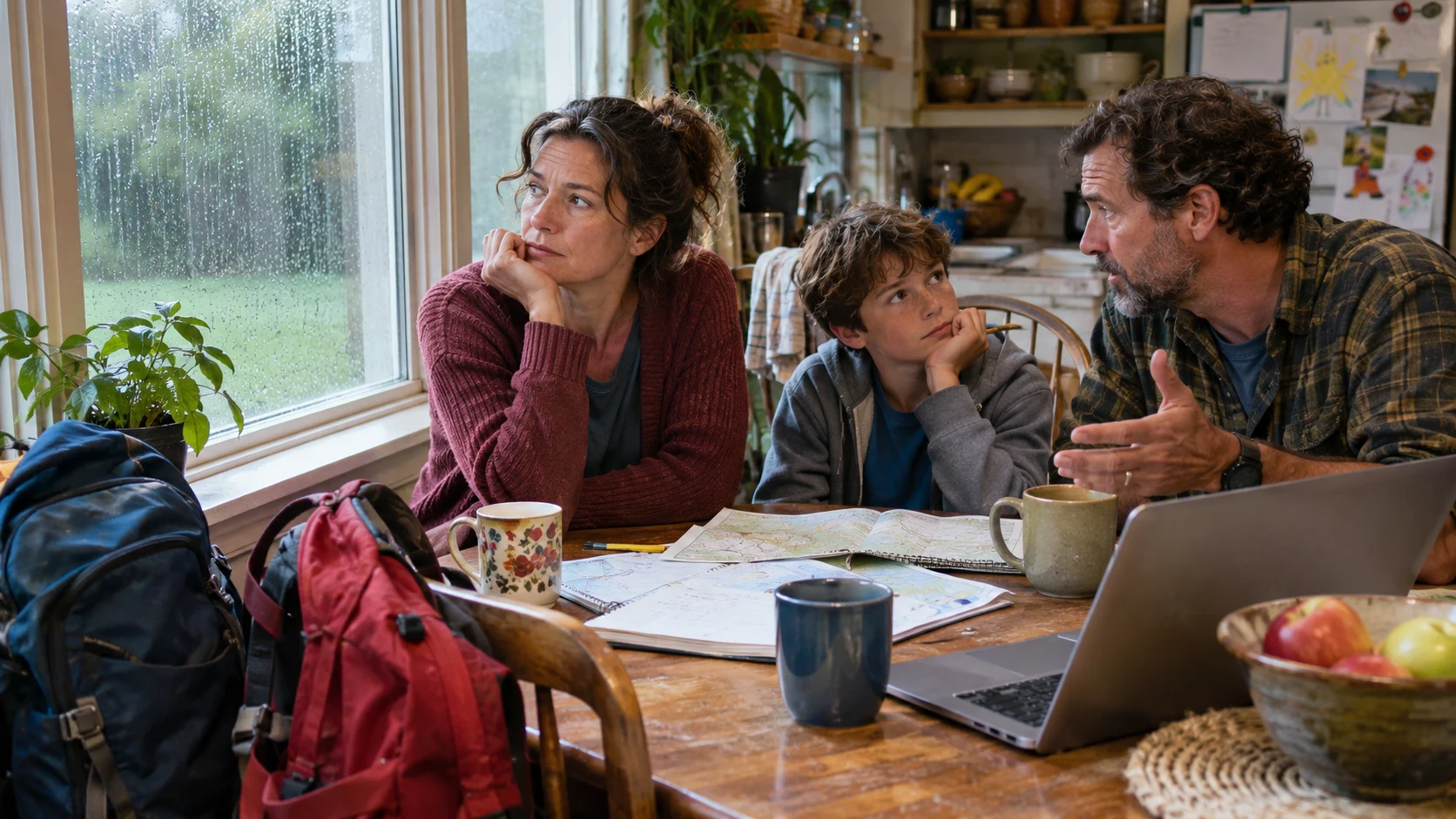
Family application: When plans change, households often experience the same event differently.
One person immediately starts building a new spreadsheet.
Another needs time to process.
Someone becomes quiet.
Someone becomes irritable.
Someone offers twelve solutions before anyone has finished explaining the problem.
Visible behavior may be carrying disappointment, fear, shame, uncertainty, or a desperate desire to regain control.
Try questions that make room for honesty:
- “What part of this change feels hardest?”
- “What are you afraid might happen now?”
- “Do you want listening, ideas, prayer, or practical help?”
- “What still matters, even though the plan changed?”
- “What do we know—and what are we only assuming?”
- “What is one decision we actually need to make today?”
Do not force instant optimism.
“Everything happens for a reason” may be intended as comfort, but it can close a conversation before the hurting person has been heard.
Presence often reaches the heart before explanations do.
Parenting application: Children and teenagers need help separating an outcome from their identity.
A child who was not selected for the team may hear, “I am not talented.”
A student whose friendship changes may think, “Nobody wants me.”
A teenager whose plan falls apart may feel that the future has disappeared.
Parents can help them:
- Name what happened truthfully
- Identify the feeling beneath the reaction
- Grieve the disappointment without becoming defined by it
- Consider what can be learned or strengthened
- Ask whether another responsible path exists
- Seek help from a trusted adult when the situation is unsafe or too large to manage alone
- Take one next step instead of demanding an instant replacement dream
Compassion does not eliminate responsibility. A young person may be genuinely disappointed and still need to apologize for hurtful behavior, complete unfinished work, or accept a reasonable consequence.
Grandparenting application: Grandparents can bring calm when younger family members feel that one closed door has ruined everything.
Share stories of a time when:
- Your plans changed unexpectedly
- A rejection redirected you
- You needed to begin again
- Waiting revealed information you did not yet have
- God’s provision arrived through an unexpected path
Tell the story without turning it into a lecture. Wisdom is easier to receive when it sounds like companionship rather than a courtroom closing argument.
Whether you live alone, with relatives, with friends, as a couple, or in a busy multigenerational household, the principle remains: make room for disappointment, seek truth, and refuse to let panic make every decision.
5. Take the Next Faithful Step
Adult and family reflection questions
- Which plan am I holding so tightly that I cannot consider another faithful route?
- What has recently changed in our family?
- Have we clearly named what was lost?
- Are we treating an inconvenience as a closed door—or ignoring a genuine warning?
- What reliable facts do we need?
- What does Scripture make clear about our responsibilities?
- Who can offer wise counsel without increasing the drama?
- Is fear pushing us toward a rushed decision?
- Is pride keeping us attached to a plan that no longer serves its purpose?
- Have we listened to each family member’s experience of the change?
- What important purpose remains, even if the original method is no longer possible?
- Is there a boundary or another person’s decision we need to respect?
- What is the next faithful step—not the entire ten-year plan?
- Where might God be inviting us to serve, grow, or begin again?
Today’s challenge: P.I.V.O.T.
Choose one changed, delayed, or blocked plan.
- Purpose: Write down what truly mattered beneath the original plan.
- Investigate: Name what changed, what was lost, and what remains possible.
- Verify: Consider Scripture, prayer, wise counsel, responsibilities, and reliable facts.
- Open: Identify at least two responsible routes you may not have considered.
- Take: Complete one faithful next step within the next twenty-four hours.
That step might be making a call, revising a budget, requesting counsel, completing an application, offering an apology, scheduling an appointment, or simply pausing long enough to stop making decisions from panic.
You do not need the entire map before taking the next faithful step.
A changed route is not the end of a meaningful life. God’s purpose is larger than the path you originally pictured.
Prayer
God, You see every plan that has changed and every disappointment we are carrying. Give us humility when our preferred route closes, wisdom to understand what is happening, and patience when the next direction is not yet clear. Keep us from calling every inconvenience a message from You, but also keep us from stubbornly ignoring wise redirection. Help us grieve honestly without surrendering hope. Teach our family to listen well, seek truth, respect healthy limits, and support one another without rushing to control the outcome. Show us what purpose remains and give us courage to take the next faithful step when it becomes clear. Lead us with Your wisdom, steady us with Your presence, and use even unexpected roads for Your good work. Amen.